
Shandong Qixia Decorative Flower Buns Gain Popularity Online: Copyright Protection Paves New Path for Traditional Craft
Source: China News Service
Authors: Wang Jiaoni, Zhang Bingcui, Bai Lei
Photographer: Zhou Tiancong
"Sir, I'd like to order another 36 steamed bun bouquets!" "These steamed bun bouquets make unique wedding favors; I want to order 50 sets for my May Day wedding!" In Qixia City, Yantai, Shandong Province, post-2000s artisan Zhou Tiancong's creatively designed bouquet-style flower buns have gone viral on social media, leading to a continuous stream of online and offline orders.
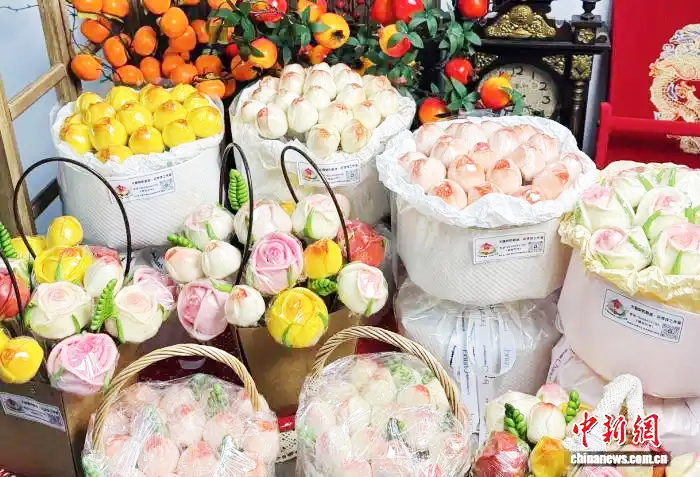
During the Year of the Horse Spring Festival season, sales of Qixia flower buns were robust. The leading enterprise, "Jiaodong Little Daughter-in-Law," alone sold 50,000 units of creative flower bun gift boxes, injecting new vitality into this traditional craft.
The successful "breakout" of flower buns owes much to a dual support system of creative innovation and copyright protection. As a "Hometown of Folk Art in Shandong Province," Qixia City is rich in intangible cultural heritage resources, including paper-cutting, clay sculpture, and Jiaodong flower buns. However, for a long time, ambiguous ownership rights and susceptibility to infringement hindered the innovative development of these traditional crafts.
To address this bottleneck, Qixia City established a strategic framework of "Consolidating Foundations through Protection, Clarifying Ownership through Rights Confirmation, and Facilitating Transformation through Innovation." The city formed a "Qicai" copyright service team composed of administrative personnel, legal advisors, and volunteers, shifting from "waiting for registrations" to "providing door-to-door services," offering one-stop support to cultural and creative enterprises and rural workshops.
Post-2000s artisan Zhou Tiancong once faced significant challenges. Last year, he combined traditional flower bun techniques with local apple imagery and winter elements to create the "Binbin" and" Guoguo" figurines. The works became popular online but were quickly met with malicious counterfeiting. The Qixia copyright management department intervened promptly, guiding him through the copyright registration process and providing legal grounds for him to protect his rights.
Clay sculptor Qu Xiaoqian had a similar experience. In 2024, her "Taiping Jixiang" (Peace Auspicious Elephant) figurine won an award at a creative competition in Yantai. However, during the promotion of her work, its original design was copied and imitated without permission for commercial sale. Upon learning of the situation during a visit, the "Qicai" copyright service team explained copyright knowledge to her and provided copyright registration services. "Product before action, copyright first" has since become a guiding principle in her creative process.
To date, Qixia City has completed over 23,000 copyright registrations related to folk arts and facilitated cooperation between more than 3,700 copyrighted works and industrial sectors. Notably, copyright registrations for Jiaodong flower buns have grown from zero to over 3,000 in just two years, forming a virtuous cycle of "innovation–rights confirmation–transformation."
"With the protection of copyright, we dare to innovate and invest. Traditional crafts can become new trends," said Yu Zhina, General Manager of Qixia Jiaodong Little Daughter-in-Law Food Co., Ltd. She noted that copyright protection has successfully upgraded flower buns from a traditional livelihood to a 'China-chic' cultural creative product, sold across the country.
From online popularity to industrial upgrading, the empowering effect of copyright is continuing to manifest in Qixia. A growing number of copyright-protected works, including paper-cuts, clay sculptures, carvings, and crochet items, are reaching broader markets via e-commerce platforms, with some even being exported to countries such as Japan and South Korea.