
The National Main Event of the 2025 Chinese Farmers’ Harvest Festival was held on September 23 in Dahu Chenjia Village, Zhaoyuan
Stable Rice Bags, Bountiful Vegetable Baskets, and Abundant Fruit Plates.
The National Main Event of the 2025 Chinese Farmers’ Harvest Festival was held today in Dahu Chenjia Village, Zhaoyuan.
The corn cobs on the Northwest Plain of Shandong Province are wrapped in golden coats, bending the straws; apple-laden trees in the Jiaodong Peninsula redden the hills; the plump and fat hairy crabs of the Yellow River Estuary whet diners’ appetite... As the eighth Chinese Farmers’ Harvest Festival arrives, the fields in Shandong tell the story of a bumper harvest.
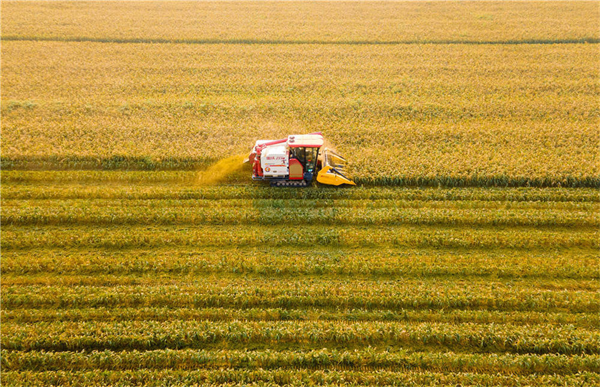
The Harvest Festival embodies the farmers’ simple expectation of “sowing a single grain in spring and reaping ten thousand grains in autumn”. Each bumper harvest is not only the result of farmers’ hard work rooted in the land, but also the concrete effort of the whole province in “storing grain in land and technology.”
“This year, I once again adopted the soybean-corn strip intercropping model. Under the guidance of agricultural technicians, the corn and soybeans grew well,” said Li Hongbo, a large-scale planter in Anlinzhan Town, Feicheng City. He has used this planting model for three consecutive years. The local agricultural and rural authorities recommended the “Denghai 605” corn variety paired with the “Lindou 10” soybean variety as a “golden partner.” Then, by scientifically configuring the crop spacing, the land can be utilized efficiently, and the crops can mutually promote each other’s growth, achieving “no reduction in corn yield while harvesting an extra season of soybeans.”
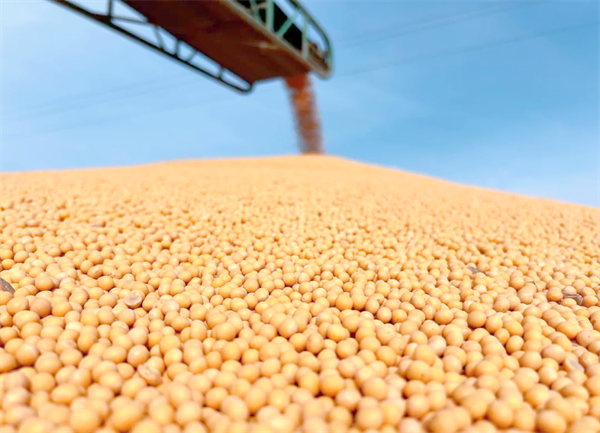
As one of China’s major grain-producing provinces, Shandong plays a vital role in national food production and bears significant responsibility in safeguarding national food security. General Secretary Xi Jinping has repeatedly made important instructions during his inspections in Shandong, entrusting the province with the critical task of “building a higher-level ‘Qilu Granary’”. In 2024, the total grain output of Shandong reached 114.2 billion jin (57.1 million tons), maintaining a stable production of above 110 billion jin (55 million tons) for four consecutive years. In 2025, Shandong achieved a summer grain yield of 452.8 kilograms per mu (about 0.067 hectares), ranking first nationwide, with a total summer grain output of 54.74 billion jin (27.37 million tons), ranking second in the country and up by 410 million jin year-on-year (205,000 tons), the largest increase in China.
Autumn grain accounts for the bulk of the annual food production. To ensure a successful autumn harvest, Shandong’s agricultural and rural authorities launched a special campaign during the critical summer sowing and management period, sending six provincial expert teams on a tour of duty to six major leading areas for large-scale grain yield per unit area improvement, such as “Dezhou-Liaocheng Tonnage-Half-Grain Zone,” “Wenyang Fields,” and “Southwestern Shandong.” Through field classrooms and on-site training, they delivered key autumn grain production technologies, including precise control and high-yield technology for corn dense planting, water-fertilizer integration technology for food crops, the enhancement of soybean yield per unit area, and soybean-corn strip intercropping technology, directly to farmers in the fields.
At present, the autumn grain crops in the whole province are growing well, laying a solid foundation for achieving another bumper harvest.
Yet this is not the whole picture of the bumper harvest. It paints a picture of stable “rice bags”, bountiful “vegetable baskets”, and abundant “fruit plates.” Despite accounting for only 6% of the country’s arable land and 1% of its freshwater resources, Shandong contributes 8% of the nation’s grain, 10% of its meat, eggs, and milk, 11% of its vegetables, and 13% of its aquatic products.
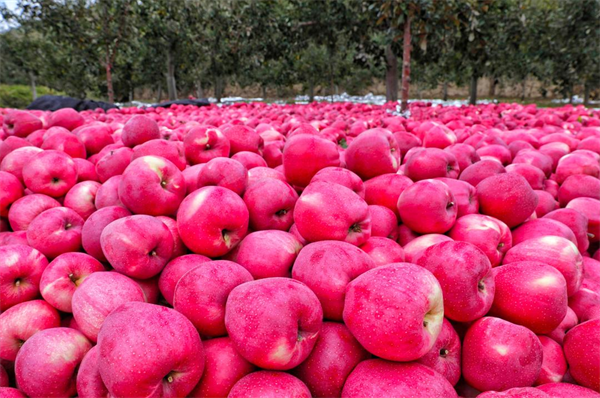
In the apple orchard in Xiaojiakuang Village, Tangjiabo Town, Qixia City, the “Jinxiu Haitang” apples have ripened. Though relatively small in size, they boast vibrant color and high sweetness. “Our village is located in the Yashan National Forest Nature Reserve, enjoying a unique mountain microclimate with large day-night temperature differences, which is especially suitable for apple growth. In recent years, by renovating old orchards and planting new varieties, our apples have become highly marketable,” said Wang Pengji, the secretary of the Party branch of Xiaojiakuang Village. In 2019, the Shandong Institute of Pomology established a science and technology poverty alleviation base in the village, providing free “Jinxiu Haitang” saplings. This variety requires neither fruit thinning nor bagging, making it relatively easy to manage. It now sells for over 8 yuan per jin (1 jin is equivalent to 0.5 kg) in supermarkets.
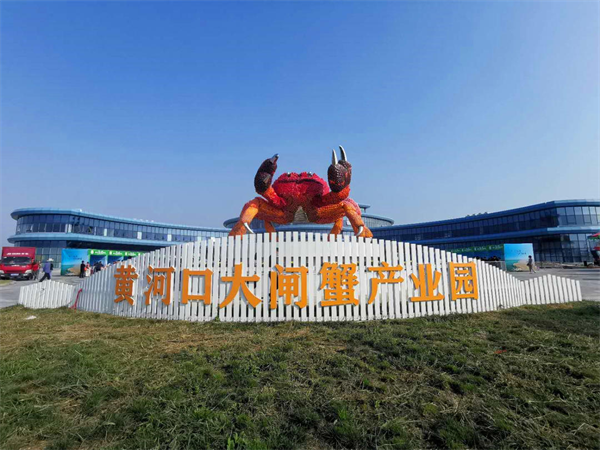
In the Yellow River Estuary Hairy Crab Industrial Park in Kenli District, Dongying City, baskets of freshly caught hairy crabs are initially classified, tied with hemp ropes, pasted with traceability codes, and then shipped nationwide via cold chain logistics. The Yellow River Delta, endowed with the Yellow River’s water, the saline-alkali soil, and the 37th parallel north, provides its unique geographical conditions and ecological environment that shape the distinctive brand of the Yellow River Estuary hairy crabs. By promoting the large-scale and standardized ecological breeding, the average size of local crabs has increased from 1.8 liang (1 liang equals 0.05 kg) per crab to 3.5 liang per crab, and the average yield per mu has increased from 60 jin to about 260 jin. According to Huang Xuedong, the deputy director of the Dongying Municipal Bureau of Marine Development and Fisheries, the fine breeding area of hairy crabs in the city reaches 70,000 mu, with an expected output of 7,500 tons and an output value exceeding 1.1 billion yuan in 2025.
Harvest should also bring income. From September 19 to 22, 2025, the Qingdao Municipal Bureau of Agriculture and Rural Affairs hosted the “Qingdao Agricultural Products” event to support farmers, benefit residents, and boost consumption. Designed as an “agricultural fair,” it connected multiple activities, including supply-demand matchmaking, brand promotion, folk performances, achievement exhibitions, and public services. Over 400 high-quality agricultural products from five major categories of planting, animal husbandry, forestry, fishery, and agricultural product processing were showcased, such as Laoshan green tea, Zhuge crispy pears, Huangdao Langya chicken, “Houta” hand-pulled noodles, and “Wenfengxiang” ham. The event built a bridge connecting “Qingdao Agricultural Products” to consumers’ tables and urban-rural markets, turning the fruits of harvest into tangible income gains.
On September 23, the National Main Event of the 2025 Chinese Farmers’ Harvest Festival will be held in Dahu Chenjia Village, Zhaoyuan. Focusing on the key areas of agriculture, rural areas, and farmers, it not only reflects national elements but also highlights the distinctive Qilu characteristics, featuring one celebration gala, five achievement exhibitions, and five special activities.
(Mao Xinxin, Reporter from Dazhong News Dazhong Daily)